The Future of Coal and Its Place in Energy
How is coal's role transforming in an age of rising renewables? From clean coal technologies to industrial use, global demand to a sustainable future.
01 · Coal's Historical Role
Coal has been the backbone of the world's energy supply for centuries, powering modern economies since the Industrial Revolution.
The wave of industrialization that began in the 18th century was made possible directly by the energy coal provided. Steam engines, iron-and-steel production, and power plants all rose on coal. It became not just a fuel but one of the foundational pillars of modern civilization.
Even today, as renewables develop rapidly, coal's role in energy is still debated. Its reliability, storability, and low cost keep it an important part of many nations' energy security — especially its capacity for uninterrupted baseload power, a critical advantage over variable sources like solar and wind.
02 · Global Demand & Coal
Rising global energy demand, especially in developing nations, keeps the need for coal alive. Being an economical and easily accessible resource makes it indispensable for many countries.
- Economic accessibility: Among the lowest-cost sources per unit of energy, suitable for developing economies.
- Energy security: Domestic coal reduces import dependence, providing strategic security.
- Storability: Coal can be stored long-term without spoiling, offering flexibility against demand swings.
- Infrastructure readiness: Existing plants and distribution make coal a quick-to-deploy option.
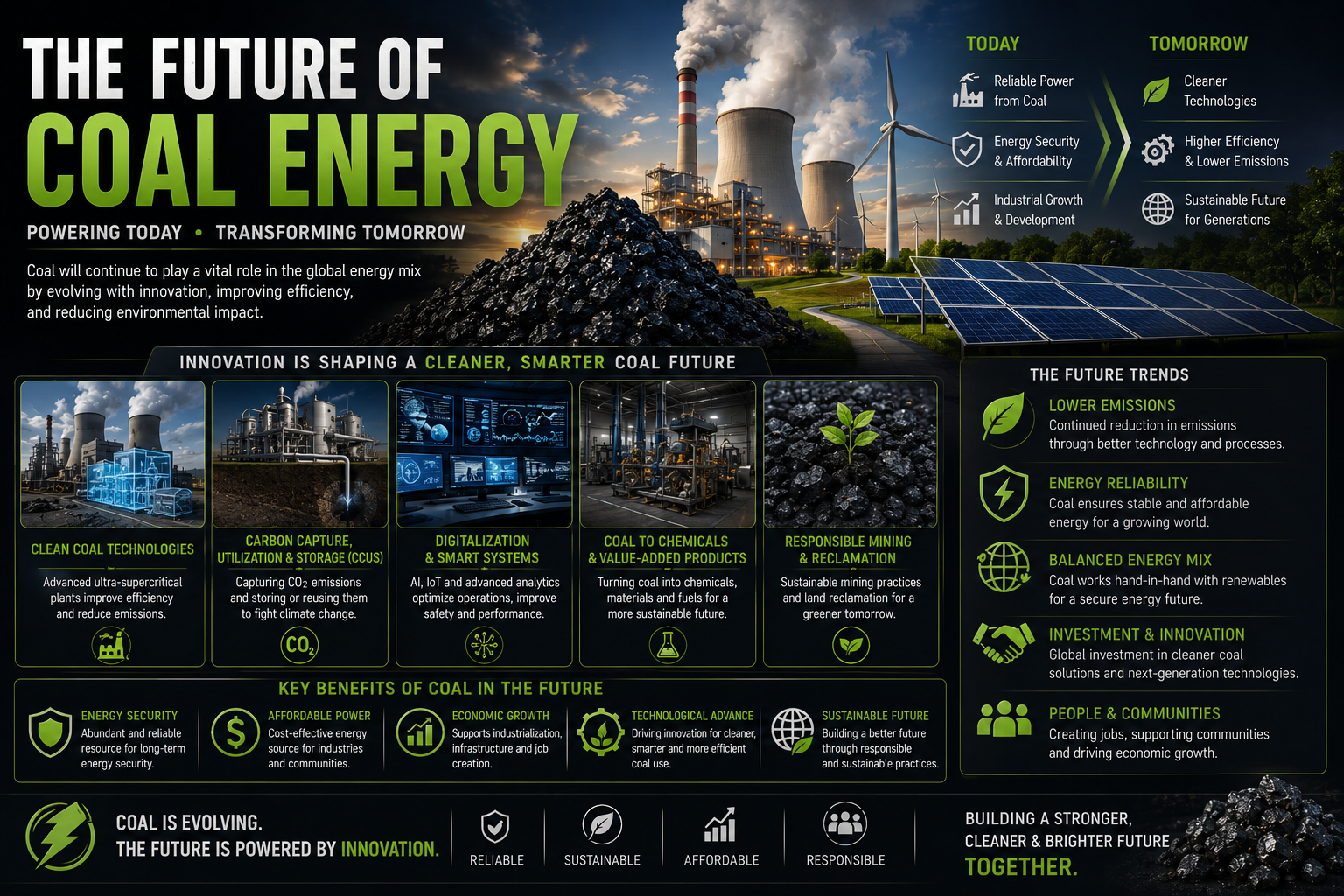
03 · Clean Coal Technologies
Environmental concerns and climate goals make transformation essential. Clean coal technologies, carbon capture, and high-efficiency plants hold an important place in coal's future.
04 · Industrial Uses
Beyond energy, coal remains a critical raw material in steel, cement, and chemical industries. Fully replacing it in these sectors seems impossible in the short term.
| Sector | Purpose | Alternative Status |
|---|---|---|
| Iron & Steel | Coke reduces iron ore | Limited (hydrogen experimental) |
| Cement | High-temperature kiln fuel | Partial (alt fuels) |
| Chemicals | Synthetic products & fertilizer | Low |
| Electricity | Baseload thermal plants | High (renewables) |
| Aluminum | Electrodes & energy | Medium |
While renewables advance rapidly in electricity, no economical alternative has matured to fill coal's place in heavy industry.
05 · Environmental Challenges & Solutions
The biggest factor shaping coal's future is its environmental impact. Climate goals push the sector toward deep transformation.
- Carbon emissions: Capture and storage systems can greatly reduce release.
- Air quality: Modern filters and treatment limit particulate and toxic-gas emissions.
- Efficiency gains: High-efficiency plants burn less coal for the same energy, lowering impact.
- Ash & waste management: Coal ash is recycled in cement and construction.
- Hybrid systems: Coal plants integrated with renewables enable a balanced transition.
06 · A Sustainable Future
Ultimately, coal retains its importance during the energy transition while evolving toward a more sustainable role. With the right technology and responsible use, it will remain part of the energy balance.
Experts agree coal won't vanish in the coming decades; instead it will persist through cleaner technologies and narrower but strategic uses. The energy transition won't happen overnight, and coal will serve as a bridge.
This balanced approach preserves both energy security and climate goals. For developing nations, responsibly used coal remains a tool for sustainable development.
07 · Quality Coal From Al Bahri
Al Bahri supplies high-quality coal for the energy, industrial, and commercial sectors, with products meeting international standards. Contact us:
- WhatsApp: 01080052971.
- Phone: 01018100698 or 01080052971.
- Email: info@bahricoal.com.
- Contact page: contact form.
Contact Us for Quality Coal Supply
With the right technology and responsible use, coal remains part of the energy future. If you seek a reliable supplier for energy, industry, or trade, Al Bahri offers international-standard solutions.
Contact via WhatsApp →