The History of Coal and the Industrial Revolution
Coal is one of humanity's most transformative resources. Discover its powerful story — from ancient times to the Industrial Revolution, from the steam engine to the modern economy.
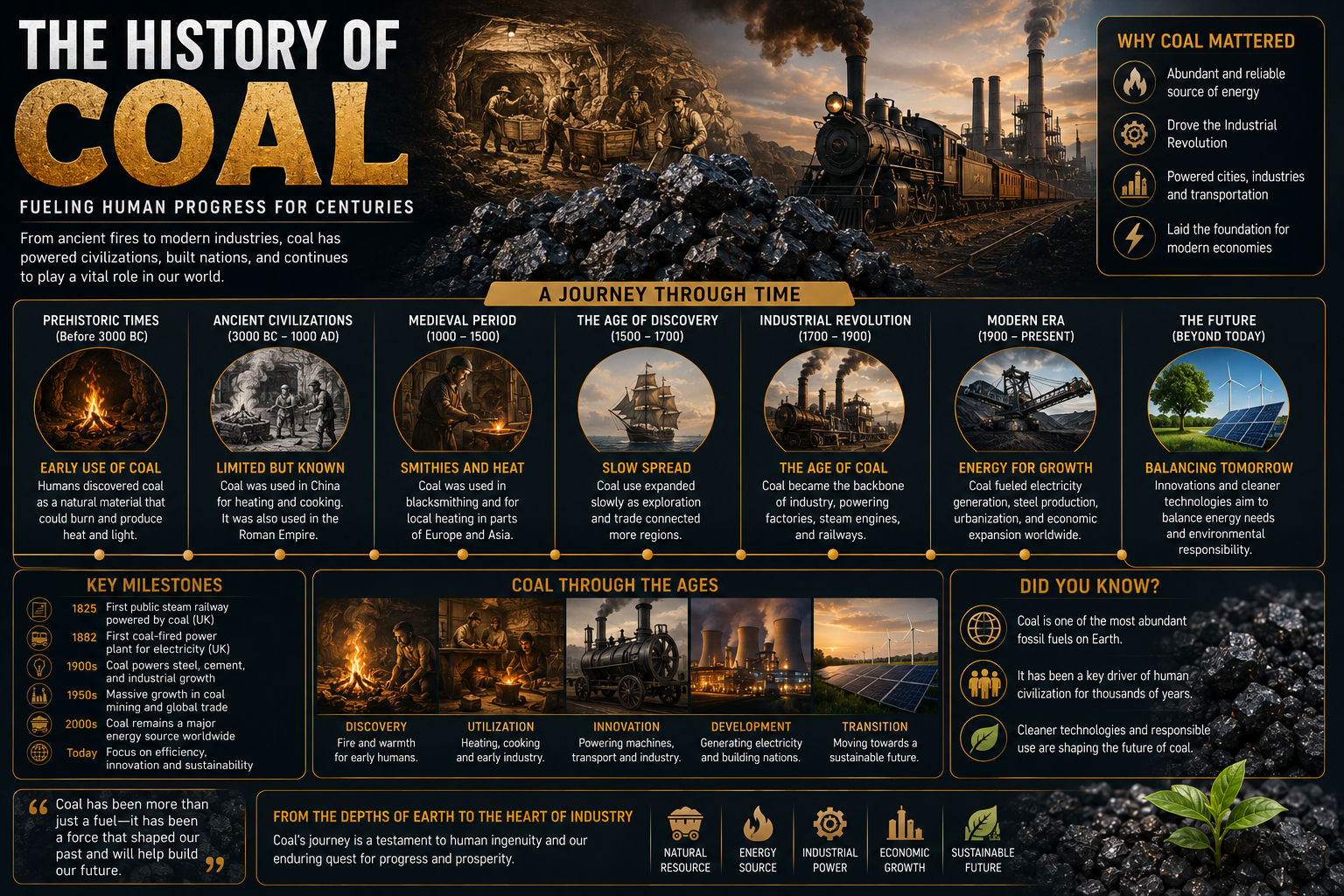
01 · Coal's First Use
Coal has served humanity for thousands of years, but revealed its true transformative power with the Industrial Revolution.
Archaeological findings show coal was used in ancient times for heating and metalworking. The Chinese used it in smelting thousands of years ago, and the Romans used surface coal for heating in Britain.
Through the Middle Ages, coal began replacing wood, especially where forests thinned. Yet its use remained limited then; coal's real potential awaited the technology to use it efficiently.
02 · Fuel of the Revolution
The Industrial Revolution that began in 18th-century Britain is unthinkable without coal. Coal was the driving force and energy source of this great transformation.
Rapidly depleting forests and rising energy needs made coal an indispensable fuel. Factories, mines, and transport systems were built on the intense, reliable energy coal provided. This era marked the shift from an agricultural to an industrial world.
03 · The Steam Engine Revolution
The real turning point in coal's history was the invention of the steam engine, which converted coal's chemical energy into mechanical power.
Thus coal-fired steam engines powered factories, ships, and trains, forming the backbone of modern industry.
04 · Coal & the Age of Steel
Coal didn't just provide energy; it also founded modern metallurgy. The development of coke revolutionized iron and steel production.
Coke enabled higher temperatures and purer iron, making possible the mass production of steel for bridges, rails, ships, and skyscrapers. Coal and steel together became the building blocks of modern infrastructure.
| Period | Development | Impact |
|---|---|---|
| 1709 | Abraham Darby's use of coke | Cheap, abundant iron |
| 1784 | Puddling process | Quality wrought iron |
| 1856 | Bessemer steel process | Cheap mass steel |
| Late 19th c | Integrated steel mills | Modern industrial infrastructure |
05 · Social & Economic Impact
Coal's rise wasn't just a technical development; it fundamentally reshaped society and economy, forming the social order of a new age.
- Urbanization: Large industrial cities grew around factories as population flowed from countryside to city.
- New workforce: Mining and factory work became a new way of life for millions.
- Economic growth: Production capacity multiplied, spreading trade and wealth rapidly.
- Transport revolution: Railways and steamships shrank distances, transforming global trade.
- Social change: Labor rights, unions, and the modern work order began forming in this era.
06 · Coal's Legacy Today
Coal has continued to shape the world since the Industrial Revolution. Its role in the energy mix has shifted, but its historical importance is undeniable.
In the modern world, coal still holds a critical place in electricity generation, steel, and cement. As renewables rise and coal is used with cleaner technologies, its legacy lives on in every corner of modern civilization.
Coal's story is also the story of humanity's relationship with energy: discovery, transformation, and progress toward a sustainable future.
07 · Quality Coal From Al Bahri
Coal has warmed and powered the world for centuries, and with the right supplier it keeps its value today. Al Bahri supplies high-quality coal for energy, industry, and trade. Contact us:
- WhatsApp: 01080052971.
- Phone: 01018100698 or 01080052971.
- Email: info@bahricoal.com.
- Contact page: contact form.
The Resource That Changed History, With You Today
Coal has been the engine of civilization for centuries, and with the right supplier it's still a powerful solution. For energy, industry, or trade, Al Bahri offers international-standard quality coal.
Contact via WhatsApp →